
A data center cooling system may look like a large infrastructure problem. But sometimes, one small component decides whether the system performs well or not.
In this case, that component was the motor driving a centrifugal pump.
The pump had to move cooling liquid at a high flow rate. It also had very little space available for the motor. So the requirement was not just about selecting a motor. It was about designing one that could deliver the right torque, work at high speed, and fit inside a very compact assembly.
The Motor Had to Support the Pump, Not Just Fit Inside It
In a liquid-based data center cooling system, the centrifugal pump keeps the coolant moving through the circuit. The impeller depends on the motor to deliver the right speed and torque.
If the motor does not perform as required, the pump cannot deliver the expected flow. That directly affects the cooling system.
The customer needed the pump to deliver between 170 and 240 litres of liquid per minute. So the motor had to do much more than simply rotate the impeller. It had to support the complete hydraulic performance of the pump.
A Standard Motor Was Not the Right Answer
The available installation space was limited. A conventional housed motor would have made the assembly larger and more difficult.
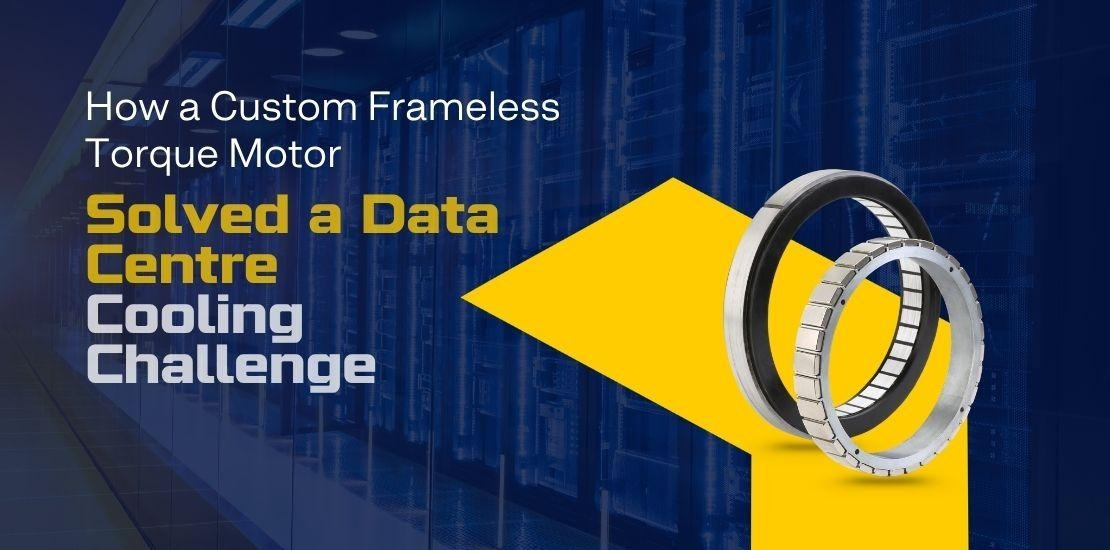
Pranshu therefore developed a custom frameless torque motor for the application.
This allowed the motor to be integrated much more closely with the pump. The housing design was also developed around the liquid path. The complete arrangement had to help the pump build pressure while keeping the motor compact.
This meant the motor, housing, impeller and pump could not be treated as separate parts. They had to be designed as one working system.
Protection Became a Key Part of the Design
The motor was operating close to the liquid path. That created another challenge.
The stator needed protection against water ingress. So Pranshu used special stator moulding and special potting on the winding. Ceramic bearings were selected to reduce rust-related concerns. The shaft was nitrided for added surface durability.
A stainless-steel housing was also used for the application.
Each of these decisions came from the actual working environment. They were not standard additions. They were required to make the motor reliable in the field.
The Final Design Came Through Close Coordination
The solution was not developed in one round.
Pranshu’s engineering team worked closely with the customer’s design team. There were multiple discussions and several design iterations.
Dimensions were reviewed. Motor performance was checked. The integration with the pump was studied again and again.
This close coordination helped arrive at the right design early in the development process.
The Result Was More Than a Compact Motor
The final motor delivered the required torque in the available space. It also supported the high-speed application without increasing the overall size of the pump assembly.
Most importantly, the pump achieved the desired liquid flow of 170 to 240 litres per minute.
For Pranshu, this was not simply a customised motor project.
It was a good example of how the right motor design can help the complete system perform better.
Because in applications like data center cooling, the right question is not only:
“Can this motor fit?”
It is:
“Can this motor help the entire system do what it needs to do?”