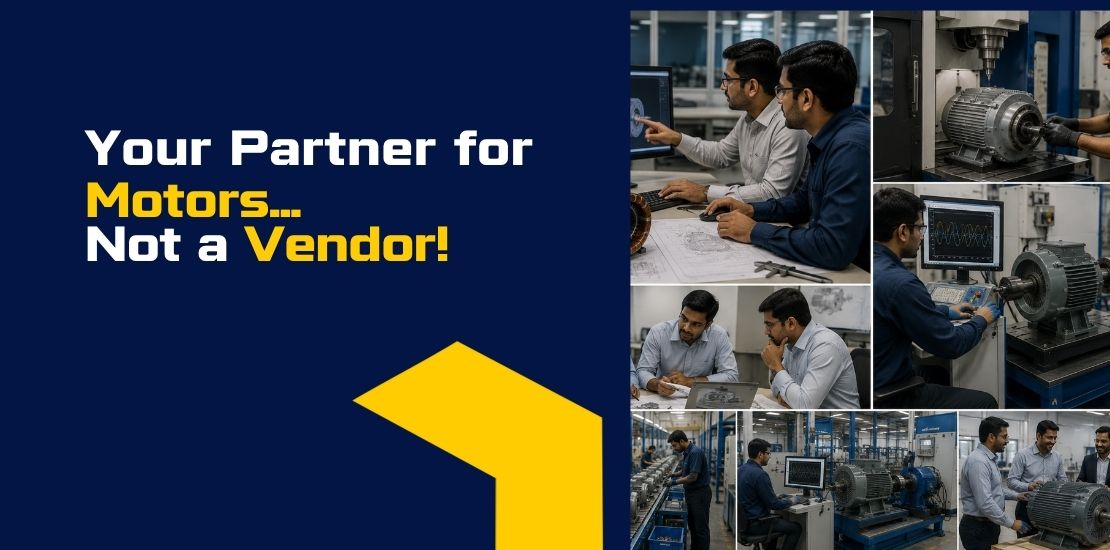
Not just a Vendor, but a Partner
The Motor Wasn’t the Problem. Understanding the Application Was.
The enquiry looked straightforward.
An OEM needed a motor for a new machine. They had the basic specifications. Speed. Torque. Voltage. Available space.
A motor could have been selected, quoted and supplied.
But one question changed the discussion.
“What exactly happens when this motor is running inside your machine?”
That is where the real engineering conversation began.
Because a Specification Sheet Never Tells the Whole Story
The motor had limited space around it. Starting torque was important. The duty cycle was not continuous. The customer also wanted easier assembly on their production line.
None of these requirements looked unusual on their own.
Together, they changed the motor requirement.
This is why Pranshu prefers to understand the application before recommending the motor.
For more than 35 years, the company has worked with OEMs, machine builders and engineers across demanding applications. The discussion often begins with the problem, not the part number.
A Good Motor Partner Knows What to Ask
What is the actual load?
How frequently will the motor start and stop?
What is the duty cycle?
How much space is available?
What temperatures will it operate in?
How will it be mounted?
Does the shaft need modification?
Will the customer’s team need easier assembly?
These questions matter.
Because sometimes the right solution needs a different winding. Sometimes the shaft or mounting changes. Sometimes an accessory needs to be developed. And sometimes the motor needs to be tested closer to its actual working condition.
That is the difference between simply supplying a motor and working on the application.
The Relationship Gets Tested When the First Design Doesn’t
Then comes the prototype.
A test may reveal higher load than expected. The customer may change the machine design. Packaging space may reduce. Production may ask for an assembly change.
This is where a motor manufacturer needs to stay involved.
Pranshu works through technical evaluations, troubleshooting and design discussions even after the first solution has been proposed. The involvement does not end with dispatch.
That Is How a Vendor Becomes a Manufacturing Partner
A vendor can supply what you ask for.
A partner should understand why you are asking for it.
For OEMs evaluating electric motor manufacturers, industrial motor manufacturers or a customized motor manufacturer in India, this can be an important difference.
The real question is not only:
“Can you make this motor?”
It is:
“Can you understand our machine well enough to help us make the right motor?”
At Pranshu, that is the kind of relationship we want to build.
Permanent Partner in Motion Control.